Showing posts with label Business. Show all posts

Friday, December 09, 2011

Delivering the Goods in Online Grocery Business

I have referred earlier to my posts on the Infosys Supply Chain blog. One went up yesterday on Supply Chain Matters, an external blog dedicated to providing viewpoints & insights into all things supply chain.

CAUTION: To those of you who are thoroughly disinterested in reading such topics and have often threatened me in the past of dire consequences for posting such 'heavy' topics, well.... a few things might help:
- this is about online shopping
- this is about activities you undertake at least once every week
- this is about a few things that need to be done by your retailer so that you continue to be happy shopping

If you have changed your mind and want to read, please go here.

As about the rest.... you have not missed much :-)


Friday, October 07, 2011

The End of Wall Street

The End of Wall Street by Roger Lowenstein - former reporter of the Wall Street Journal, writer, financial journalist and director of the Sequoia Fund - is a masterpiece that traces the fall of the markets in 2008 to events that began several years earlier. From the first page until the very end, no one is spared. Alan Greenspan is criticized for his dogged insistence that 'markets are perfect and self-regulating'; financial institutions are shredded for greed, risk taking, and excessive bonuses; home lenders are blasted for lax lending practices; ratings agencies are thrashed for inherent conflicts of interest; Republicans are called out for their visceral dislike to regulation; Democrats are exposed for their insane support of home ownership even when people cannot afford one; and ordinary citizens take blame for financing daily lives on credit and home equity.The crisis therefore was no accident, but an event waiting to happen....

The book highlights the tendency of the past three decades to glorify the wizardry of 'quants' (mathematical geniuses in Wall Street who construct elaborate risk models) and diversification (securitization) of risk. Of the former, Lowenstein's complaint is that they assumed perfect markets where home prices only marginally go down. Of the latter, he adds that 'in the eyes of each individual firm, risk was reduced. But the danger that a failing firm could bring down a host of others was slowly and steadily accreted'. 

Books like these often offer lessons in humility (which may I add has been blatantly missing in Wall Street for a long time). Stan O Neal, the head of Merrill Lynch, comes across as increasingly aloof and playing golf - alone - for 100 days a year. His salary? $48M in 2006. Many of his fellow CEOs are no better, being highly disinterested in understanding the very complex instruments that they were peddling. Vikram Pandit of Citi orders a $350 bottle of wine in a fancy restaurant to savor just one glass (the rest is discarded). In Lowenstein's words, 'On Wall Street, the habit of extravagance is deeply ingrained'. Only Jamie Dimon of JP Morgan comes out looking clean. 

Mortgage securities, CDO, default swaps, and synthetic derivatives - every topic is well explained. So is the underlying message that the crisis - unlike the Great Depression - was one of capital and not liquidity. The biggest takeaway however is that there is no such thing called a self-regulating, safe and rational market.  In that sense, the book is not really a statement on the end of Wall Street as such, but a more measured viewpoint that the old ways of working at Wall Street are coming to an end. 

Roger Lowenstein deserves kudos for taking a complex topic and peeling it layer by layer for all of us to see - and comprehend. If a fast-paced account on the last few months of the crisis in 2008 is what you are after, you are better off with Too Big to Fail (reviewed here). But if you really want to understand how the house of cards was built, The End of Wall Street is the right choice.

I am rating it 5 stars!!!

Tuesday, September 20, 2011

The Themes in Your Life

The inspiration for this blog came from two unlikely sources when it was first drafted six months ago.

The first was several years ago when I came across an article in the Fortune Magazine titled ‘What it takes to be great’ by Geoff Colvin, its senior editor-at-large. In essence, he argued that practice and hard work trump talent. The feedback to the article was so good that he subsequently penned the book ‘Talent Is Overrated’. I read the book only recently (reviewed here) but the idea that talent is not the driver to success had been firmly planted.

The second was my own experience. 16 years of working in the industry has exposed me to a variety of challenges. I have seen several people up close on how they successfully navigate everyday issues, but also have seen others – brilliant, intelligent & hard working in their own way – fail remarkably. About the latter, we just say ‘what wasted talent’ or ‘he could not make it’, and move on. Upon close observation of such folks (who span all levels of an organization from the very top to the entry-level), I was able to derive a few consistently common themes that successful individuals apply and the rest do not.

This blog is about these 4 themes. They will look very ordinary and simple. In fact, you will be very disappointed that they do not sound ‘strategic’. But I can state with confidence that imbibing them is your first step to greatness. While success in life, career, marriage and parenthood is a function of many many aspects, these four make a good beginning.

Before we get on to the themes, let us understand the meaning of precocious talent by taking an example of a person from sports that we are familiar with - Sachin Tendulkar. Die-hard fans will point to his 600+ run stand with Vinod Kambli when he was 15. They will talk about the centuries he scored on debut in the Deodhar & Duleep trophies before 16. And of course, they will rave about his fantastic innings on a bouncy track at Perth that is considered to be one of his finest test centuries before he was 20. All this is proof – they will say – that here was a player who was born with talent and destined to greatness.

But these fans are wrong. Talent is terribly overrated and the themes to success reside elsewhere.

Theme 1: Read Read Read
There are several CEOs in the world who do not play golf, but there is practically no CEO who does not read. World leaders, in addition to running their countries, read about 50-60 books per year. Lack of time or disinterest in reading is no longer an acceptable excuse. Reading opens your mind to new ideas and helps create new ‘connections’ in your head (think of it like the act of raking your head that is similar to how the farmer rakes his land before every sowing season).

Read all that you can get hold of. Fiction is fine, so are comics. Dig into economics – and yes, watch CNBC for business news - even if you don’t understand anything in the beginning. Some day, I promise you, it will all make sense. Read viewpoints from both the left and the right – regardless of your political inclinations. You will be surprised that you are not as much a die-hard capitalist or a bleeding liberal that you thought to be.

Theme 2: Write Write Write
Writing crystallizes your thinking & frames your perspective. This will make you measured – and over time – assured. Take notes…. copious notes... I once had a colleague who would get furious when people walked into his meetings with no notebook in hand. ‘It means’, he would say, ‘either what I am going to say is not important or you think you are not required’.

Theme 3: Practice, Practice, Practice
Look up the 10,000 hour rule on the internet. It states that in order to be considered an expert, you need 10,000 hours of practice. Malcolm Gladwell in Outliers argues that Bill Gates of Microsoft & Bill Joy of Sun Microsystems reached greatness by 17 because they had the opportunity to work on computers for over 10,000 hours. In Talent is Overrated, Geoff Colvin explains the elements of deliberate practice – it must be focused, involves feedback, and must be painful.

Incorporate the 10,000 hour rule in your lives. Practice before every speech, every presentation and every meeting. Expect the unexpected. An instructor once told me that before everyone arrived, I must go to the farthest chair in the room and check for font sizes and color palettes on the screen. It was from him that I learned that the days of blaming the projector were over.

Theme 4: Think Think Think
This is most difficult, and often avoided. We get so busy in our work, families, chores etc that we do not spend time to think. I will ask you to start thinking about just 3 questions.
  • What is your purpose in life? To put it bluntly, why do you exist?
  • What are your values? In short, what do you stand for?
  • How do you want to be measured on the day you die?
Start asking these questions from today. I promise you that you will not find the answers right away. Or tomorrow. Or the day after. These will take years. But if you don’t give up, one day you will find them. And that is when you will discover your life’s true calling.

In conclusion, I go back to Sachin Tendulkar. In case you insist that he was just talented, think again. 10+ hours of cricket from the time he was 11. Facing bowlers in the nets from 18 yards instead of 22 to improve his reflexes. A body that has more dents than your bike or your car. Sachin Tendulkar - a true embodiment of deliberate practice. I rest my case.

Sunday, September 18, 2011

L.L. Bean - Big Shoes To Fill

An advantage of working with Retail clients is that you understand the method and the madness in deciphering consumer behavior. A lot of thought goes into the layout of the aisles, arrangement of items and diversity of choice. You develop immense respect for retail specialists and store associates whose business it is to observe buying patterns, develop insights, remain innovative, and offer an experience that buyers can cherish. 

But to me, the true measure of the iconic nature of a company is reflected in its culture, depth of innovation and interactions with its customers. These principles were in full play during my previous US trip when friends of mine strongly recommended that I visit the flagship L.L. Bean store at Freeport, Maine. That two hour visit inside this 24-hour-365-days-a-year store showed me just why this company is so adored by millions around the world. 

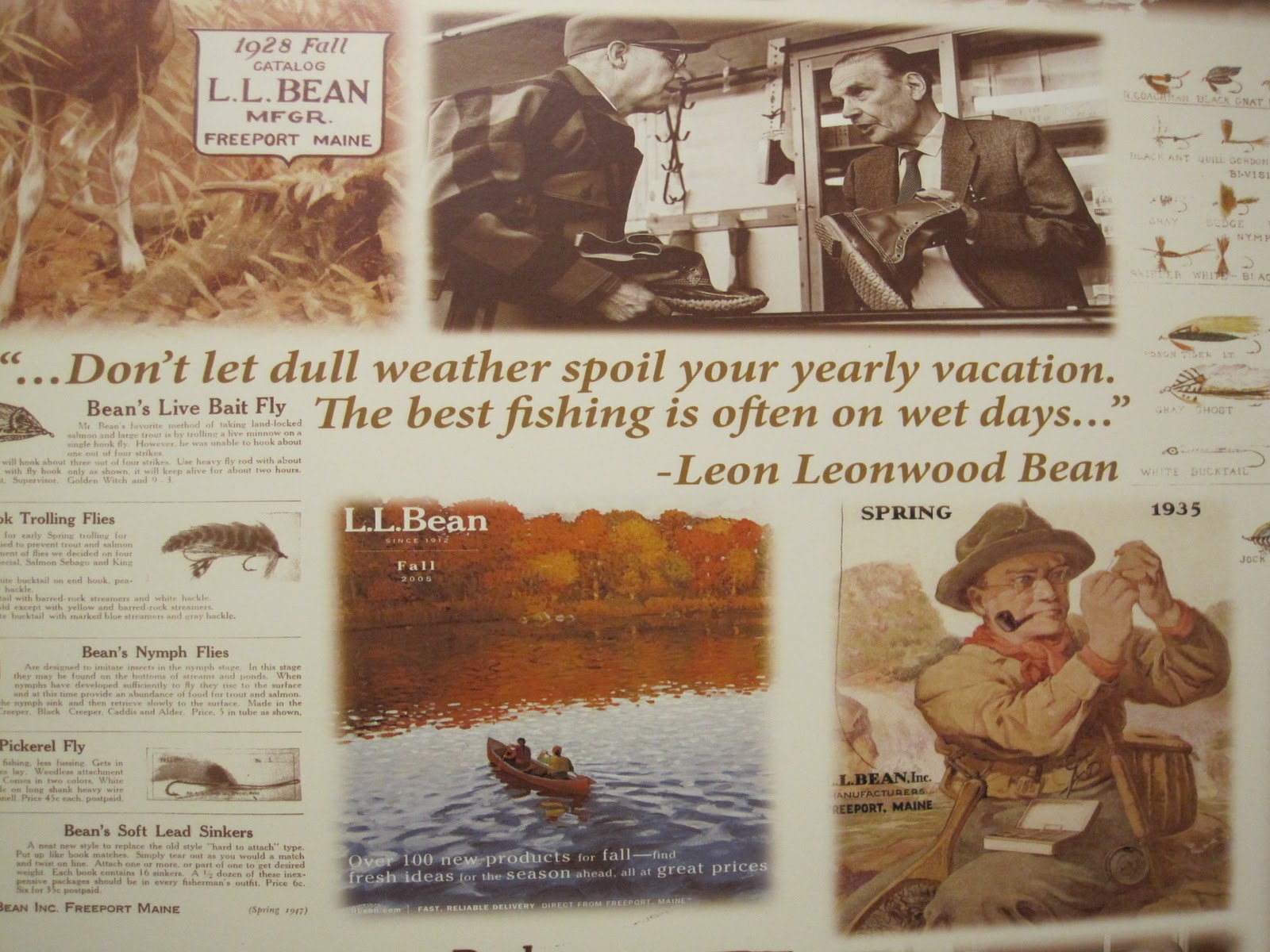
L.L. Bean is a privately held retailer specializing in clothing and outdoor recreation equipment. It has stores in the US & Japan, but derives a large share of revenues via its mail-order catalog and the web. Even before you enter, you get a flavor of its customer service and innovation. A large mock-up of its first-ever product, the Maine Hunting Shoe, frames the entrance. 

As you watch kids – and adults – pose by the shoe, a poster to its left proudly proclaims its lineage. In 1912, Leon Leonwood Bean returns from a hunting trip with cold damp feet, and thus is born the idea of a shoe with waterproof rubber bottoms and leather uppers. He sells 100 pairs to fellow hunters and sportsmen. 90 are returned because the stitching that connects the leather and rubber gives way. Although it nearly puts him out of business, he refunds the customers' money and improves the shoe design. A unique mail-order catalog company takes off.

An associate greets me as soon as I enter. I tell him where I am from and that I have been encouraged to visit even though I do not hike, shoot or fish. He smiles, offers a store map, tells me what to look for (there's tons of apparel and home furnishings to consider) and asks me how else he can help. I ask him something that I am sure will be met with either a 'No' or 'Let me check with my manager'. I ask him if I can take pictures. 'That's fine, take as many as you want' he says. I have been to 9 countries, worked in 6, have visited retail outlets in every one of them – and I can say with confidence that not many associates are empowered to give that answer in a flash in the cut-throat world of retail. Less than 10 steps into this store and I am already impressed.

You see memorabilia from the past. The first shoe.... the sewing machine where it all came together... and that classic quote by L.L. Bean that is relevant not just in fishing, but also to life (and may I say, to investing as well:-)).


As you walk further, you understand how one drives innovation by working closely with world-class requirements, pushing products to their limits of endurance, and constantly thinking of customers' needs.

You also realize that when you go into a store, you do not buy a product but live an experience. That explains why right next to a hunting platform (machaan) that is on sale, there is also a mannequin with the right apparel and gear.


But most of all, it dawns on you that their statements on customer satisfaction go right into their DNA. Above their check-out counter is a philosophy born 100 years ago that is relevant even today. It is their famed Return Policy that allows you to return their product any time after you buy if you are not satisfied. 

Outstanding values, great products, fantastic shopping experience, and phenomenal customer service. The recipe for true customer delight. We all know this - it is neither original nor unique. But only when you visit a world-class store like L.L. Bean (Apple store is the other that comes to mind) do you understand how all these ingredients must come together.

Don't miss this store when you are in Maine next.

Monday, March 30, 2009

Fallout at General Motors

Rick Wagoner, the CEO of General Motors, has been ousted. The latest casualty in the current economic saga of approaching the US Federal Govt for helping in the bail-out of the private sector.

I was just commenting to one of my friends a few hours earlier that while I was generally comfortable with the bail-out of the financial sector (including AIG), bailing out Detriot was something else. Not trying to save (temporarily in some cases) AIG and other financial firms clearly had the risk of a global meltdown (see Carol Loomis). I also have no doubt that the ripple effects of the fall of the American auto makers will be profoundly felt (including in my former home-state of Michigan). But the fact remains that there are better managed and more efficient companies to drive the industry forward when we all come out of this horrendous economic mess (yes - we will come out; after all, nothing ever lasts). I am not talking just about the Japanese. Even Ford has been making a number of much required changes for some time now.

Make no mistake. Rick Wagoner was a very good executive. Alex Taylor mentions this in Fortune - and some.

The markets may not like this. The Dow is down as I write. Asian markets fell today. But no one will doubt that GM's existence, at least in its present form, was clearly untenable.